
A large moving box seems useful until you fill it with books and can barely lift it. Buy only small cartons, though, and packing your bedding becomes an awkward job. Choosing moving boxes starts with what you own, how heavy it is and how much protection it needs.
For a home move, you will usually need a mixture of small and medium cartons, a few larger boxes for lightweight belongings, and suitable packaging for fragile or unusually shaped items. The number depends on the contents of your home, not simply its floor area.
At Best Movers HK, we help customers assess their packing requirements before moving day. This guide explains the box types, sizes and estimating steps that will help you prepare for a move in Hong Kong.
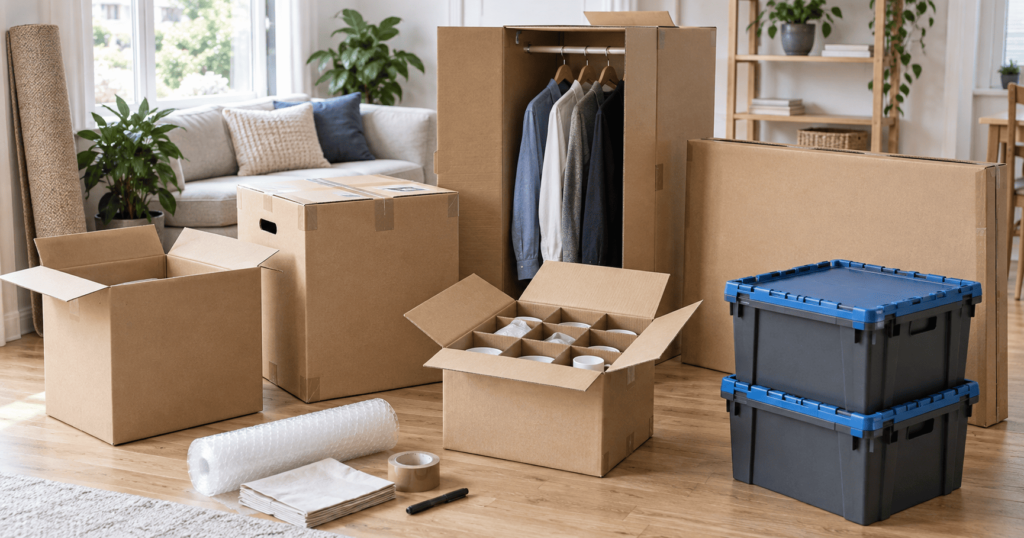
Types of Moving Boxes and When to Use Them
Standard Cardboard Moving Boxes
Corrugated cardboard cartons work well for many everyday belongings. They can be folded flat before use, labelled clearly and stacked when properly packed.
Choose clean, dry boxes with intact corners and secure flaps. A carton that has become soft, torn or misshapen should not be relied on to protect your belongings.
Heavy-Duty Moving Boxes
Double-wall cartons have an additional layer of corrugated board. They are an option for heavier contents or belongings that need a more substantial outer box. Packaging guidance from FedEx recommends double-wall boxes for heavier goods and cushioning to prevent movement.
Check the carton’s stated limits and use appropriate padding. A stronger box does not make an overloaded carton easy to carry or protect unwrapped glassware by itself.
Wardrobe Boxes
Wardrobe boxes have a hanging rail for clothes that you want to transport on hangers. They can be useful for coats, suits and dresses.
Check the rail length and internal height before buying. Long garments need enough clearance, and the rail has a loading limit. Avoid adding heavy loose items underneath hanging clothes unless the box supplier permits it.
Dish and Glassware Boxes
These cartons may include dividers that keep individual items apart. Wrap pieces separately, use suitable cushioning and check that the compartments fit your glasses or crockery.
Dividers help organise the contents, but they do not replace protective packing. Leave enough space for wrapping rather than squeezing items into an undersized compartment.
TV, Mirror and Picture Boxes
Flat or adjustable cartons are designed around items that do not fit comfortably in a regular moving box. Measure the item’s full dimensions, including its frame or stand where relevant, and allow for protective materials.
If you still have the original TV packaging with its fitted inserts, ask the movers whether it remains suitable. Large mirrors, valuable artwork and unusually shaped pieces should be assessed individually.
Reusable Plastic Moving Crates
Rigid crates may suit a local move where collection and return can be coordinated. Before hiring them, check their dimensions, lid security, stacking instructions and return deadline.
Pack only clean, dry belongings. A plastic container should not be treated as waterproof unless it is specifically rated for that purpose.
Moving Box Sizes and What to Pack in Each
Terms such as “small” and “large” are not standard across suppliers. Check the actual measurements, whether they describe the inside or outside of the carton, and the space needed for cushioning.
| Box size | Approximate example dimensions in cm | Suitable contents |
| Book box | 30 × 30 × 30 | Books and other compact, dense belongings |
| Small | 42 × 32 × 32 | Small household items, tools and heavier contents in manageable quantities |
| Medium | 46 × 46 × 41 | Kitchen utensils, folded clothing and everyday household items |
| Large | 46 × 46 × 61 | Lampshades, soft toys and other lightweight, bulky items |
| Extra-large | 61 × 46 × 61 | Duvets, pillows and bulky bedding |
These rounded examples are based on U-Haul’s moving box size guide. They are a size reference, not a catalogue of cartons supplied by Best Movers HK. Measurements are length × width × height.
The useful rule is simple: put dense items in smaller cartons and reserve larger boxes for lighter belongings. Do not fill a large box with books just because there is room left.
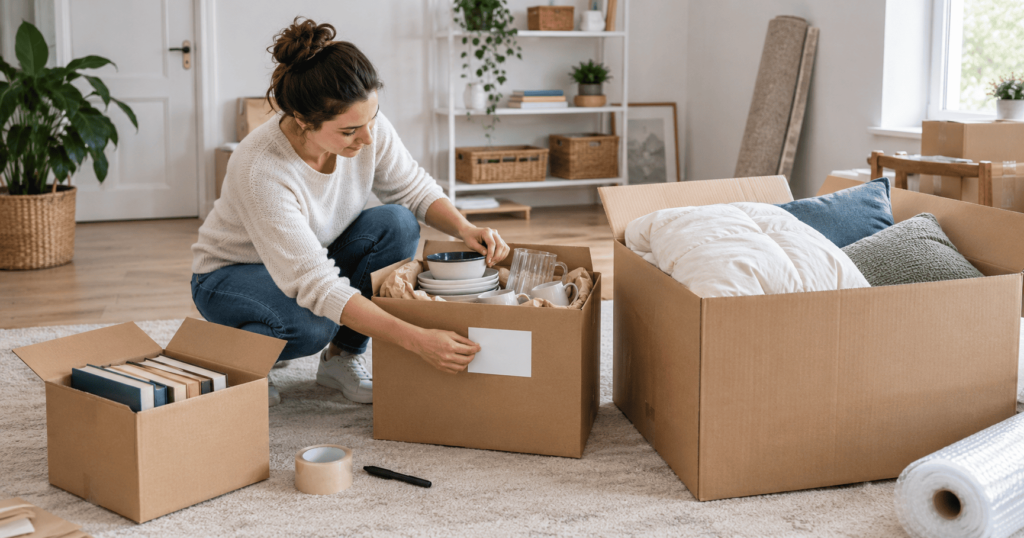
How Many Moving Boxes Do You Need?
Bedroom count gives you a starting point, but the amount stored inside cupboards, drawers and shelves matters more. A compact flat with extensive book collections and kitchenware may need more cartons than a larger, lightly furnished home.
| Home size | Broad starting estimate |
| One room or small studio | 10–20 boxes |
| One-bedroom flat | 20–40 boxes |
| Two-bedroom flat | 40–80 boxes |
| Three-bedroom flat or house | 80–100 boxes |
These general ranges come from Storage World’s moving box guide. They are not Hong Kong household averages or guaranteed quantities. Your carton sizes, possessions and packing choices will affect the total; count specialist packaging separately in your own plan.
Estimate Your Boxes Room by Room
Start by deciding what will actually move. Then work through each room and record what needs a carton, what needs specialist packaging and what can travel in a suitable suitcase or another agreed container.
- Open every cupboard and drawer. Include items stored under beds, above wardrobes and in utility areas.
- Group similar belongings. Separate books, kitchenware, clothing, bedding and fragile pieces so you can choose suitable box sizes.
- Test-pack a representative group. Packing one shelf of books or a section of kitchenware gives you a better guide than guessing from the outside of a cupboard.
- Count specialist boxes separately. Include hanging clothes, mirrors, pictures and electronics where needed.
- Allow a small reserve. Around 10% extra standard cartons is a practical planning allowance, not a fixed requirement.
For example, if your room-by-room estimate is 30 standard cartons, you could plan for 33. Add any wardrobe or picture boxes identified separately. This is an illustration of the method, not an estimate for a particular flat size.
If you would prefer help assessing or packing your belongings, our local moving services in Hong Kong can include full or partial packing assistance according to your booking.
How to Pack Moving Boxes Properly
Seal the Base Before Filling
Use suitable packing tape across the centre seam and both edge seams to form an H shape. Seal the top the same way after packing. This approach follows FedEx’s packaging guidance.
Folding the bottom flaps together without tape is not a secure substitute.
Cushion Items and Fill Gaps
Wrap fragile pieces individually and use suitable padding to limit movement inside the carton. Keep heavier contents below lighter items, without placing weight on delicate pieces.
The flaps should close flat. If the sides bulge or you need to force the lid down, repack the contents into a more suitable box.
Keep Each Box Manageable
Follow the carton’s stated capacity and any instructions from your movers. There is no single weight limit suitable for every box or person carrying it.
Split dense contents between smaller cartons when necessary. A box that remains structurally intact can still be too awkward or heavy to handle comfortably.
Label for Delivery and Unpacking
Mark the destination room and a brief description on the top and at least one side. A label such as “Kitchen 03: plates and bowls” is more useful than “Miscellaneous”.
Keep a numbered list on your phone or on paper. Mark the cartons you want opened first, and keep keys, medication, essential documents and valuables with you.
Choosing Boxes for Storage or an Overseas Move
Boxes Going Into Storage
Check that both the carton and its contents are completely dry before packing. Label items clearly and decide what you may need to retrieve during the storage period.
For Hong Kong storage, discuss humidity-sensitive belongings such as books, electronics and artwork with the provider. A sealed carton alone does not control the storage environment. Our storage services can be discussed alongside collection and return delivery, with facility features and access arrangements confirmed before booking.
Boxes for International Moving
Speak to the moving team before buying all your cartons or sealing everything. Overseas packing must suit the items and transport arrangements, and some belongings may need specialist protection.
Ask how boxes should be numbered and how to describe their contents for the shipment inventory. Best Movers HK’s international moving services include packing and documentation support, helping you coordinate these requirements as part of the relocation.
What to Do With Boxes and Unwanted Items
Decluttering before packing gives you a more useful inventory and reduces the number of unwanted belongings arriving at your new address.
Keep usable cartons for another move or offer them for reuse. Check local collection requirements before putting damaged cardboard out for recycling.
If you also have unwanted furniture or household items, ask about our disposal services. Confirm the accepted items and collection arrangements in advance, and keep them clearly separate from belongings being moved.
Frequently Asked Questions
Can I reuse delivery or supermarket boxes?
You can consider clean, dry cartons with sound corners and intact flaps for suitable items. Avoid boxes with moisture damage, odours or weak bases. Use packaging appropriate to the item’s weight and fragility rather than choosing a box only because it is free.
Should I buy mostly large moving boxes?
Usually, a mix works better. Large cartons suit bulky, light contents, while smaller cartons make dense belongings easier to handle. Base the mix on your inventory rather than buying one size for everything.
Are boxes included when I hire movers?
That depends on the agreed package. Ask whether cartons, tape, protective materials, packing labour and any specialist packaging are included. Confirm when materials will arrive if you are doing the packing yourself.
Plan Your Packing With Best Movers HK
Best Movers Hong Kong Limited was established in 2012 by Mr. Singh, with a focus on service quality and customer relationships. Our surveyors can visit your home at a convenient time and assess the details that affect your move.
Send us photographs or an inventory of your belongings, your moving date and both addresses. Mention any fragile items, storage needs or overseas shipping requirements so we can discuss suitable packing support.
Call +852 2777 7509 to request a moving assessment and quotation.